Abstract
Fertigation system is useful to reduce labor and enhance crop productivity. Before implementing the fertigation system in open fields, it is necessary to compare the economic advantages between fertigation and conventional fertilization. This study assessed the yield and fertilizer use efficiency of eggplant when fertigation and granular fertilizers were applied, and when phosphorus was supplied either as a basal fertilizer or through fertigation. Treatments were granular fertilizer application (S) and fertigation (F). In the fertigation treatments, the ratio of basal application and fertigation for phosphorus was treated to zero (F0), 100:0 (F1), 50:50 (F1), 0:100 (F3), and nitrogen, potassium was fixed at 20:80%. Fertilizer amounts were applied equally to all treatments according to fertilization recommend by soil testing. The yields of eggplants in F1 were increased by 4.6 tons/ha (8.0%) compared to S. And the yields of phosphorus fertigation treatments (F2 and F3) were increased by 1.2 tons/ha (1.0%) compared to F1. The nitrogen concentration in eggplant leaves decreased to 2.5% during the later growth stages with granular fertilizer, whereas it remained in the range of 3.4~4.3% with fertigation. At harvest, the phosphorus concentration in eggplant leaves and fruits were higher as the increase of phosphorus fertigation ratio. Fertilizer use efficiency was higher with fertigation compared to granular fertilizer. And fertilizer recovery efficiency of phosphorus fertigation treatments (F2, F3:14%) were higher than basal application of phosphorus (F1:4.6%). Therefore, fertigation is more advantageous than granular fertilizers for cultivating eggplants in open fields. Also, it is recommended to supply phosphorus through fertigation with nitrogen and potassium.
Keywords:
Eggplant
Fertigation
Fertilizer use efficiency
Phosphorus
서 언
비료는 작물의 뿌리 활착과 초기 생육을 위하여 밑거름으로 주고, 작물 재배 중 양분 공급이 필요한 시기에 웃거름으로 준다. 웃거름을 주는 방법은 일반적으로 입상비료를 표토에 뿌려주는데, 작물이 있는 상태에서 토양과 비료를 골고루 혼합하기 어렵기 때문에 일부는 농경지 밖으로 유실되어 작물의 비료이용효율이 떨어지게 된다[1].
관비는 물과 비료를 함께 주는 방법으로서 작물 재배기간 동안 양분을 주기적으로 나누어 공급하므로 양분이용효율을 높일 수 있다[2]. 또한 국외에서는 노지 작물 재배 시 관비를 통해 질소 비료를 나누어 공급하여 질산태질소의 용탈을 관리한 사례가 있다[3]. 최근에는 시설재배지 뿐만 아니라 노지채소 재배 시 노동력 절감과 생산성 향상을 위해 농식품부 주관으로 스마트팜 모델 개발 사업을 추진하고 있으며, 작물별 주산지를 중심으로 관비 시스템을 보급하고 있다. 가지는 국내 주요 과채류 중 하나로 서 노지와 시설에서 모두 재배되고 있고, 재배면적은 2023년 기준으로 노지 437 ha, 시설 277 ha이다[4]. 가지는 약 4개월 이상 연속하여 수확하기 때문에 과실 수확기에는 주기적으로 비료의 공급이 필요하다[5]. 노지 가지 재배 시 관비 시스템 도입을 검토하기 위해서는 기존 입상비료 시용과 관비 처리에 따른 생산성과 비료이용효율에 대해 검증할 필요가 있다.
입상비료 사용과 관비 공급에 따른 작물 생산성에 대한 연구결과를 보면, 감자는 지중 점적관비를 했을 때 수량은 약 12~18% 정도 증가했다고 하였으며[6,7], 점적관비로 비료를 주었을 때 수량은 20%, 양분이용률은 26% 정도 증가했다고 하였다[8]. 노지 토마토는 비료 전량을 관비로 공급했을 때 과수량이 19.9% 증가했으며, 질산태질소의 용탈도 줄였다고 하였다[9].
관비는 작물이 필요한 시점에 양분을 공급할 수 있기 때문에 이용률이 낮은 비료성분의 효율을 높일 수 있다. 관비는 대부분 질소와 칼륨을 위주로 공급하나, 토양에 쉽게 고정되는 인산을 함께 관비로 공급하면 토양과 반응하기 전 작물이 쉽게 인산을 이용할 수 있어 작물의 이용효율을 높일 수 있다[10]. 유효인산이 낮은 토양에서 토마토 재배 시 인산을 밑거름으로 준 처리구와 관비로 준 처리구를 비교했을 때 과실 생산량은 약 6%가 증가했고, 인산 최적 관비량은 밑거름 인산 처리구의 약 60% 정도로서 관비 처리 시 인산비료 이용률이 높았으며[11], 가지 또한 토마토와 마찬가지로 인산을 관비로 공급할 때 생산량에도 긍정적인 효과를 미칠 것으로 예상된다.
본 연구는 노지 가지 재배 시 입상비료와 관비 처리를 비교하고, 질소와 칼륨은 관비로 공급한 상태에서 인산 전량 밑거름, 밑거름과 관비 50:50, 전량 관비로 처리했을 때 작물 양분흡수, 비료 이용효율, 작물 생산성을 평가하여 관비 효율과 인산 적정관비 공급 비율을 제시하고자 하였다.
재료 및 방법
노지 가지 관비 재배시험 개요
노지 가지의 관비 공급비율, 관비 공급과 입상 비료 사용에 따른 비료이용효율을 평가하기 위하여 경북 상주시 낙동면 승곡리에서 2023년 4월부터 9월까지 재배시험을 수행하였다. 시험 토양의 토양통은 장천, 표토 토성은 미사질 양토이고, 토양 화학성은 pH 6.4, 유기물 30 g/kg, 유효인산 489 mg/kg으로 밭 토양 적정범위 내에 해당하였다(Table 1). 각 시험구의 면적은 200 m2이며, 단구제로 배치하고, 각 구 내에서 임의로 3구역으로 구분하여 정식 후 60, 77, 110, 135, 170일차 시료채취를 하고, 1~2일 간격으로 수량조사를 하여 총 수량을 구하였다. 비료는 작물별 비료사용처방에 따라 토양검정 비료추천량에 맞추어 처리하였다[5]. 가지 정식 전 석회고토 200 kg/10a, 혼합가축분퇴비 330 kg/10a를 살포한 후 경운하였다. 밑거름은 정식 1주일 전에 요소, 용성인비, 황산칼리로 주었고, 관비는 요소, 일인산칼리(0-52-34), 황산칼리를 각 처리구별 해당량만큼 나누어 사용하였다(Table 2). 가지 재배기간 중 평균 기온은 20.8℃, 최소 7.9℃에서 30.2℃의 범위였으며, 총 강우량은 1,415 mm이었고, 6월말부터 7월 중순까지 총 620 mm의 강우가 있었다(Fig. 1). 기상 데이터는 대기 온도 센서(ATMOS14, METER, USA)와 강우량 센서(ECRN-100, METER, USA)로 수집하였다.
처리구는 관비구와 입상비료구로 구분했는데, 관비구는 국립농업과학원에서 진행한 선행연구에 따라 질소와 칼륨의 관비 비율을 80%로 고정하고, 인산 무비구(F0), 인산 전량 밑거름구(F1), 인산 밑거름 50%와 관비 50% 처리구(F2), 인산 전량 관비구(F3)로 처리하였다. 2023년 4월 28일에 가지를 정식하고, 관비구는 웃거름량을 총 관비횟수만큼 나누어 5월 22일부터 1주일 간격으로 비료를 공급하였다. 입상비료구(S)는 토양검정 비료사용처방서에 표기된 대로 밑거름을 사용하고, 웃거름은 6월 15일부터 30일 간격으로 3회 나누어 주간 사이에 시용하였다. 가지는 6월 20일부터 1~2일 간격으로 수확하였으며, 9월 23일에 수확을 종료하였다. 관비로 사용한 비료는 요소, 인산칼리, 황산칼리이며, 관비공급을 위해 각 처리별 관수통에 비료를 넣어 혼합하였고, 관수 기준은 토양수분포텐셜 –25 kPa을 기준으로 하여 점적관을 통해 자동 관수 하였다. 관수는 관비구와 입상비료구가 동일하게 처리되었다.
토양, 식물체 분석
시험 토양은 비료 처리 전에 0~15 cm 깊이까지 10지점에서 채취하여 복합시료를 제조하였다. 토양은 풍건하여 2 mm 체로 걸러 분석에 사용하였으며, 농촌진흥청의 토양 분석법에 따랐다[12]. 토성은 비중계법으로 분석하였으며[13], 토양 pH와 EC는 1:5의 비율로 진탕하여 pH, EC meter (Thermo scientific, USA)로 측정하였다. 유기물은 0.4 N K2Cr2O7⋅H2SO4 혼합용액을 넣고 5분간 가열한 후 적정하여 유기물 함량을 구하였다. 유효인산은 Lancaster법으로 720 nm에서 UV Spectrometer (Hitachi, Japan)로 비색정량하였다. 질산태질소는 토양과 2 M KCl을 1:5의 비율로 침출하여 질소 자동분석기(BRAN+LUEBBE, Germany)로 분석하고, 교환성 양이온은 1 M NH4OAc (pH 7.0)으로 침출하여 ICP (Thermo scientific, USA)로 분석하였다.
가지의 시기별 양분함량과 양분흡수량을 구하기 위하여 정식 후 60일, 77일, 110일 135일, 170일차 시료를 채취하였다. 잎, 줄기, 과실을 나누어 분석하였으며, 수분이 많은 과실은 잘게 잘라 상온 건조 후 잎, 줄기와 함께 80℃에서 48시간 동안 건조하여 건물중을 측정하였다. 식물체는 부위별로 분쇄하여 건조 시료 0.5 g을 377 mM H2SO4과 36% HClO4를 혼합한 침출액 5 mL로 습식 분해하고, 여과한 분해액을 희석하여 질소, 인산, 칼륨 함량을 분석하였다[14]. 식물체 양분흡수량은 잎, 줄기, 과실의 성분함량과 건물중을 곱하여 단위면적으로 환산하였다.
비료 이용효율, 작물 생장률, 통계 분석
노지 가지 재배 시 관비, 입상비료 처리에 따른 비료 이용효율을 비교하기 위하여 가지의 양분흡수량을 질소, 인산, 칼리 비료시용량으로 각각 나누었다[15].
Fertilizer use efficiency : U/F (kg/kg)
U: crop nutrient uptake with applied fertilizer (kg/ha), F: amount of fertilizer applied (kg/ha)
인산 비료 관비 공급에 따른 비료회수율을 비교하기 위하여 인산 처리구에서 무처리구의 인산 흡수량을 빼고, 인산 비료량으로 나누었다[15].
Phosphorus fertilizer recovery efficiency (%) : (Uf – U0) / fertilizer P × 100
Uf: crop nutrient uptake with applied fertilizer (kg/ha), U0: crop nutrient uptake with fertilizer untreated (kg/ha), F: amount of fertilizer applied (kg/ha)
가지 재배기간 중 처리구별 작물 생장률은 1달을 기준으로 식물체 1주당 1일 가지 생산량 차이를 구하였다[16].
Relative growth rate (RGR): 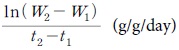
W: dry weight, t: day
통계분석은 SAS 7.13 (SAS Institute Inc., NC, USA)을 이용하였으며, 입상비료와 관비 공급에 따른 가지 수량, 비료이용효율은 t-test를 수행하였다. 인산 관비공급 비율에 따른 인산비료 회수율, 가지 수량은 Duncan’s multiple range test (DMRT)를 수행하였으며, 가지 수량과 가지 잎과 과실의 질소, 인산, 칼륨 성분 간 상관관계는 Pearson’s correlation으로 분석하였다.
결과 및 고찰
관비 공급과 입상비료 시용에 따른 양분이용효율
일 당 가지 생장률(RGR)은 관비 공급과 입상비료 처리구 모두 유의한 차이는 없었으나, 생육 초반인 6월에는 약 0.3 g/g/day, 강우가 많았던 7월과 기온이 높았던 8월에는 0.15~0.17 g/g/day, 생육 후반인 9월에는 0.2 g/g/day로 생육 초반에 비해 일 생장률이 감소하는 경향을 보였다(Fig. 2).
입상비료와 질소, 칼륨 관비 공급에 따른 식물체의 양분흡수 차이가 있는지 확인하기 위하여 재배기간 중 잎과 과실의 양분함량을 비교하였다(Fig. 3). 생육 중반인 정식 후 77일차까지는 두 처리간 유의한 차이는 없었으나, 생육 중반부터 후반기 접어들수록 관비 처리구(F1)에서 질소와 칼륨 흡수량이 입상비료보다 높은 것을 확인하였다. 관비공급 시 질소는 잎에서 3.4~4.3%의 범위를 보인 반면, 입상비료(S)는 생육 초반에는 4.4% 이었으나, 수확후기에는 2.5%까지 떨어지는 것으로 나타났다. 과실의 질소 함량은 F1과 S 모두 수확후기로 갈수록 감소하는 양상이었으나, 관비 처리 시 입상비료를 시용한 것 보다 약 0.6% 정도 높게 나타났다. 잎의 칼륨 농도 또한 110일차부터 1~2%정도 관비 처리구에서 높게 유지되었다. 입상비료 사용 시 정식 후 90일차까지 질소와 칼륨 웃거름을 시용했으며, 135일차에는 토양 질산태질소 농도가 1ppm 이하, 교환성 칼륨은 0.13 cmolc/kg로 떨어져 가지가 흡수할 수 있는 질소와 칼륨이 관비 처리구에 비해 적었기 때문인 것으로 판단된다.
관비와 입상비료 전체 처리구에 대해 가지 잎, 과실의 NPK 함량과 과실의 수량을 상관분석 한 결과, 과실의 질소, 인 농도가 과실의 수량과 유의한 상관이 있는 것으로 나타났다(Table 3). 관비를 공급했을 때 가지의 잎과 과실의 성분함량이 증가하고, 이로 인해 가지 생산성을 높일 수 있다는 것을 알 수 있었다.
관비와 입상비료 사용에 따른 질소, 인산, 칼리질 비료 1 kg당 가지의 흡수량을 비교했을 때, 관비 처리구에서 질소는 0.18 kg/kg, 인산은 0.06 kg/kg, 칼리는 0.29 kg/kg이 높았다(Table 4). 따라서 관비를 공급했을 때 시용한 비료의 이용효율이 유의하게 높은 것을 알 수 있었다.
인산 관비 공급에 따른 인산 흡수 및 인산 비료 회수율
인산 관비 공급 및 관비 공급 비율에 따라 작물의 인산 흡수 차이가 있는지 확인하기 위하여 잎과 과실의 인 함량을 비교하였다(Fig. 4). 재배기간 중 잎과 과실의 인 함량은 유사한 양상을 보였으며, 수확기에는 인산 관비 공급비율이 클수록 잎과 과실의 인 함량이 함께 높아 작물 재배기간 동안 웃거름으로 인산을 공급했을 때 식물체의 인산 농도에 영향을 미치는 것을 알 수 있었다. 이는 토마토에서 NK 관비에 비해 NPK를 관비를 공급했을 때 인산 흡수가 약 15% 높았다는 연구결과와 유사하였다[9].
인산 밑거름(F1)과 관비공급(F2, F3)에 따른 인산 흡수량은 F1에 비해 F2와 F3에서 11 kg/ha가 많았다(Table 5). 질소와 칼륨 흡수량은 인산 무비구(F0)에 비해 인산을 공급했을 때(F1~F3) 인산 흡수량과 함께 증가하였다. 질소, 인산, 칼륨은 서로 시너지 효과를 내는 원소로서[17], 인산을 공급함에 따라 질소, 칼륨도 동반하여 흡수량이 증가한 것으로 보인다.
인산 처리구에서 인산 무비구의 흡수량을 빼고, 인산 비료량으로 나눈 인산 비료 회수율을 비교했을 때 인산 밑거름 시용 시 4.6%의 회수율을 보인 반면, 관비로 인산을 50% 공급(F2), 인산 전량을 관비로 공급(F3)했을 때 약 14% 정도로 비료 이용률이 높았다. 인산은 비료이용률이 낮은 원소로서 pH가 높은 석회질 토양의 경우 액상 형태로 인산을 공급하면 침전을 감소시켜 비료 이용효율이 높일 수 있으며[18], 본 연구에서도 인산의 관비 공급이 작물의 인산 효율을 높이는 데 효과적인 것을 알 수 있었다.
관비 공급에 따른 노지 가지의 생산성
관비 공급에 따라 가지 생산성이 증가하는지 확인하기 위하여 질소와 칼륨을 관비 처리(F1~F3)와 입상비료 처리구(S)의 수량을 비교한 결과, 통계적으로 유의한 차이를 보였다(p<0.05) (Fig. 5). F1과 S의 가지 수량 차이는 ha당 4.6톤(8.0%)이었으며, 수량 증가분을 농가 소득으로 환산하면 가지 1kg당 2,184원(’23)[19] 기준으로 ha당 약 1,000만원에 해당하였다.
인산을 밑거름과 관비로 공급했을 때 가지 수량을 비교해 보면, 인산을 전량 밑거름으로 준 F1과 밑거름 50%, 관비 50%를 준 F2는 수량 차이가 없었다. 그러나 인산 전량을 관비로 공급한 F3와 F1, F2의 가지 수량을 비교했을 때 F3에서 ha당 약 1.2톤 (1%) 정도 많았다. 본 연구에서 시험 전 토양의 유효인산 함량은 적정범위에 해당하여 생육 초반에 인산이 부족한 조건이 아니었고, 인산이 뿌리 활착의 제한인자가 아니기 때문에 밑거름으로 인산을 주지 않고 관비로 전량 공급해도 생산성을 유지한 것으로 추측된다. 따라서 토양의 유효인산 함량이 낮지 않은 조건에서는 개화 및 착과 시기에 관비로 인산을 공급하면 생산성 향상에 도움이 될 것으로 판단되었다.
관비와 입상비료 사용에 따른 작물 생육을 비교한 연구 결과에 의하면, 가지는 점적 관비를 공급했을 때 질소 비료량을 20% 줄여도 관행시비와 비교했을 때 작물 생육 차이가 없었으며[20], 블루베리는 입상비료를 줄 경우 관비의 1.5배를 공급해야 동일한 수량을 수확할 수 있었다[21]. 또한 포도는 입상비료에 비해 관비를 주었을 때 뿌리 분포가 많았다고 하였다[22]. 또한 점적관비 효과를 메타분석 한 연구에 의하면, 질소 비료의 이용효율을 34.3% 높여 작물 생산성을 높이는데 기여한다[23]. 위의 결과들을 종합해 볼 때 관비는 입상비료에 비해 노지 가지의 생산성을 높이는데 유리한 방법이라고 판단된다. 그러나 노지 작물에 관비 시스템을 도입하기 위해서는 추가적으로 관비 시스템 설치 비용과 관비 공급에 따른 노동력 절감 효과 등 경제성을 종합적으로 분석하여 판단해야 할 것이다.
Data Availability: All data are available in the main text or in the Supplementary Information.
Author Contributions: Y.-S. Song carried out the experiment and wrote the primary manuscript. Y. Lee developed the concept for this experiment, revised the manuscript and supervised the findings of this work.
Notes: The authors declare no conflict of interest.
Acknowledgments: This work was carried out with the support of “Cooperative Research Program for Agriculture Science and Technology Development (Project No. RS-2021-RD009879)” Rural Development Administration, Republic of Korea.
Additional Information:
Supplementary information The online version contains supplementary material available at https://doi.org/10.5338/KJEA.2024.43.30
Correspondence and requests for materials should be addressed to Yejin Lee.
Peer review information Korean Journal of Environmental Agriculture thanks the anonymous reviewers for their contribution to the peer review of this work.
Reprints and permissions information is available at http://www.korseaj.org
Tables & Figures

Table 1.
Physical and chemical properties of the experimental soils
a) Optimum range of chemical properties in the upland soils
[8].

Table 2.
The amount of fertilizer for eggplant cultivation recommended by soil testing
a) Fertilizer amount was set by soil testing equations of fertilizer application recommendations
[5].
b) Fertilizer application rates (%) through fertigation during the eggplant cultivation.

Fig. 1.
Temperature and rainfall during the eggplant fertigation experiment of Sangju in 2023.

Fig. 2.
Relative growth rates of eggplant according to fertigation ratio (F) and surface application of granular fertilizer (S).
F0 (NK 80%, P untreated); F1 (NK 80%, basal application of P); F2 (NK 80%, P basal 50%:fertigation 50%); F3 (NK 80%, P 100% fertigation application). Means with standard deviation (n=3).

Fig. 3.
Nitrogen and potassium concentration of leaf (a, c) and fruit (b, d) of eggplant according to N, K fertigation (F1) and surface application of granular fertilizer (S).
Means with standard deviation (n=3).

Table 3.
Correlation coefficient between fruit yields and nitrogen, phosphorus, potassium concentration of leaf and fruit in the eggplant cultivation
Pearson’s correlation coefficient, *
p<0.05

Table 4.
Fertilizer use efficiency of eggplant by fertigation and surface application of granular fertilizer
Means ± standard deviation (n=3).
t value is the result of t-test statistics (*
p<0.05).

Fig. 4.
Phosphorus concentration of leaf (a) and fruit (b) of eggplant according to fertigation ratio of phosphate fertilizer. F1 (NK 80%, basal application of P); F2 (NK 80%, P basal 50%:fertigation 50%); F3 (NK 80%, P 100% fertigation application).
Means with standard deviation (n=3).

Table 5.
Nutrient uptake and phosphorus fertilizer recovery efficiency of eggplant by phosphorus fertigation ratio
Means±standard deviation (n=3).
Within each variable, means followed by the same letter are not differ significantly at p<0.05 (DMRT).

Fig. 5.
Fruit yields of eggplant according to fertigation ratio (F) and surface application of granular fertilizer (S).
F0 (NK 80%, P untreated); F1 (NK 80%, basal application of P); F2 (NK 80%, P basal 50%:fertigation 50%); F3 (NK 80%, P 100% fertigation application). Means with standard deviation (n=3). Within each variable, means followed by the same letter are not differ significantly at
p<0.05 (DMRT).



